Starlight and Sound and on a Wilderness River
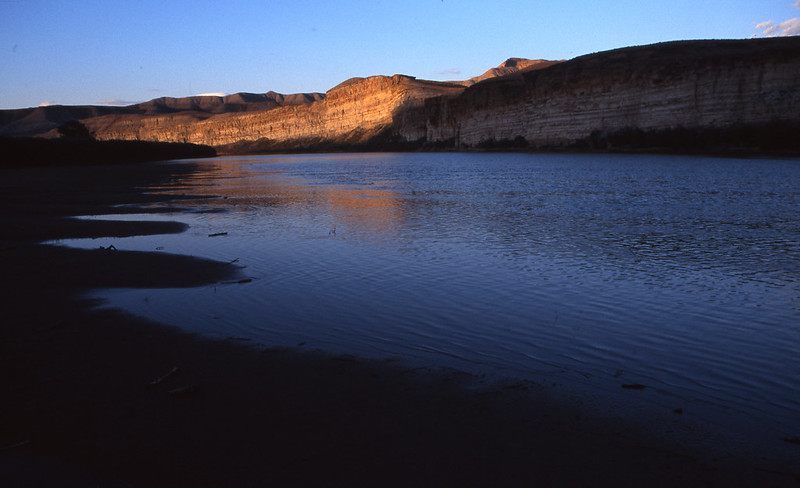
The Green River was singing a quiet song to us that evening, its current circling in languid eddies as it flowed past our sandbar camp. River music blended with the flutter of cottonwood leaves in the bosque behind us, while birds called from the riverside willows. Here was the peacefulness I had hoped to find on this trip, a six-day rafting adventure in Utah’s Desolation Canyon.
There were nine of us in camp that evening—I and my wife, a couple our age from Baltimore with their two young grandsons, a middle-school teacher from Brooklyn, and our two guides, one of whom was our daughter. We were two days into our trip with Holiday River Expeditions, a Utah adventure outfitter, and this would turn out to be our only really clear evening.
I stretched out on the warm sand next to the Baltimore family, waiting for the first stars to appear. I take a proprietary interest in our Utah desert sky, out here where little artificial light intrudes, and that evening I hoped that our new friends would get to see the whole celestial display. One by one the bright stars which form the Summer Triangle--Vega, Altair, and Deneb--showed themselves. Jupiter and Saturn would have been in view, but were hidden behind the rocky rim which rose above the river’s far shore.
The day’s light slowly faded and the sky was painted with hundreds, then thousands of stars. I pointed out the constellation Sagittarius, the celestial archer, often represented as half-man, half-horse. In August it stands high in the southern sky, its drawn bow facing to the west. Sagittarius lies amid the brightest part of the Milky Way, toward the center of our galaxy, within which several tiny star clusters stand out as gems laid upon the heavenly canvas. This sight never fails to impress me, even with eyes dimmed by age.
As we gazed at this display, a meteor appeared from off to the right, streaking from west to east, straight through Sagittarius. A true bolide, it sped across the sky as if the archer’s loosed arrow had drawn cannon fire in return. The fireball flared twice before breaking into fragments and burning out. I gasped and shouted to the others in our party, who were off chatting among themselves, but they missed it. We five, including the two young boys, were lucky to be looking in the right direction.
*
A scene like this lingers in memory, long after the boats and gear are stowed and the sunburns fade. Other memories blend together, like the sunrises creeping down canyon walls, waves crashing over the bow of the raft, the quiet post-dinner conversations that seem to flow as naturally as water. The river’s current continued to affect me after we’d returned home; for several days I was unsteady on my feet, as if I’d spent a month at sea. Even my dreams rocked me in gentle rhythms, with images of shimmering water and canyon walls floating by.
Drifting down this stream, our guides would pull out inflatable kayaks for us to paddle through the easier sections. I got dunked in one small rapid, but this immersion only made me more grateful for the free-running river. I wanted to offer something in return--a bit more than just leaving a clean camp every morning. To give thanks not only for the life that thrives along a flowing, undammed stream, but for the surrounding wild lands—part of which now enjoy the protection of federal wilderness law, as the Desolation Canyon Wilderness, which Congress had enacted the previous March.
If there were no longer any wild rivers, no protected parks or wilderness areas, it would be much harder to experience moments such as that star-filled evening on a warm sandbar. In a world increasingly dominated by humans and their noise, lights, and industry, the chance to look up at an undimmed sky against the background of a softly flowing river becomes more elusive each year.
*
The following year, on another float trip my wife and I made on a different stretch of the Green River, a different light show appeared in the night sky. It was late September, and I was looking to the northwest, where the Big Dipper hung low on the horizon. Seven bright orbs emerged over the cliffs and rose upward, one after another. Again I called to my companions, and we followed their course against the background of stars. But these moving lights affected me in a very different way than the meteor which had thrilled us the previous summer. These were just a few of the thousands of communication satellites which a certain rich individual has launched into low orbit, having gotten the permission of exactly no one. I shuddered, knowing that the night sky—one of the last natural treasures we all hold in common--is swiftly becoming another field for enacting our dreams of conquest. Glowing orbs traverse the heavens in such abundance that they can interfere with astronomical observations. One day they may eclipse the constellations humans have beheld for countless millennia.
Soon, too, we may begin injecting vast amounts of sulfate chemicals into the stratosphere in an effort to curtail the sun’s energy. A night sky littered with stars may become a thing of the past. So too may quiet evenings on our favorite wild river disappear, as Utah’s political leaders seek to expand oil and gas drilling on our public lands, or simply offer them up for sale to private investors. There’s no telling where this may end up—although the ancients, with their myths of arrogant gods written across the sky, had an idea of how it all would turn out.
As human artifice increasingly takes over every place we live, dominating every field and every view, I long for a new mythos that will guide our earth-keeping. Surely a river is one place to look. In a culture that is obsessed with finding and exploiting new sources of energy, and with controlling not only the Earth’s surface but the atmosphere and the heavens above, some quiet time spent on a river can be instructive. If we drop our busyness and our money-seeking for a while, and let a river’s unfettered waters propel us downstream, we may be reminded that we are part of a more ancient flow.
That August evening on the Green, I wanted to believe that the river was our real home. Not the world of machines and power we had left behind. If that is an illusion, I find it a necessary one, for how else might we stay connected in some small way to the planet which gave us life? How do we hold on to those values which are expressed in starlight, in the sound of cottonwood leaves in an evening breeze, or in the murmur of a softly flowing river? I search for answers, and for some way to grapple with the forces that would take all this from us.
* * *